It’s Wednesday and you’re looking for inspiration for the weekend. Until very recently, that meant starting with a vague idea, doing some searching, and working through multiple options before committing to anything.
That’s changing. Instead of searching, comparing, and piecing together a plan, AI can now convert that vague “we should do something” into a fully formed, bookable recommendation. In this world, it’s not enough for exhibitors to simply appear in search results; they need to be a moviegoer’s top recommendation with the right movie and format, at their preferred cinema, with seats available at a time that works. That’s the promise of agentic commerce, and it’s rapidly moving from ‘coming soon’ to ‘now showing’.
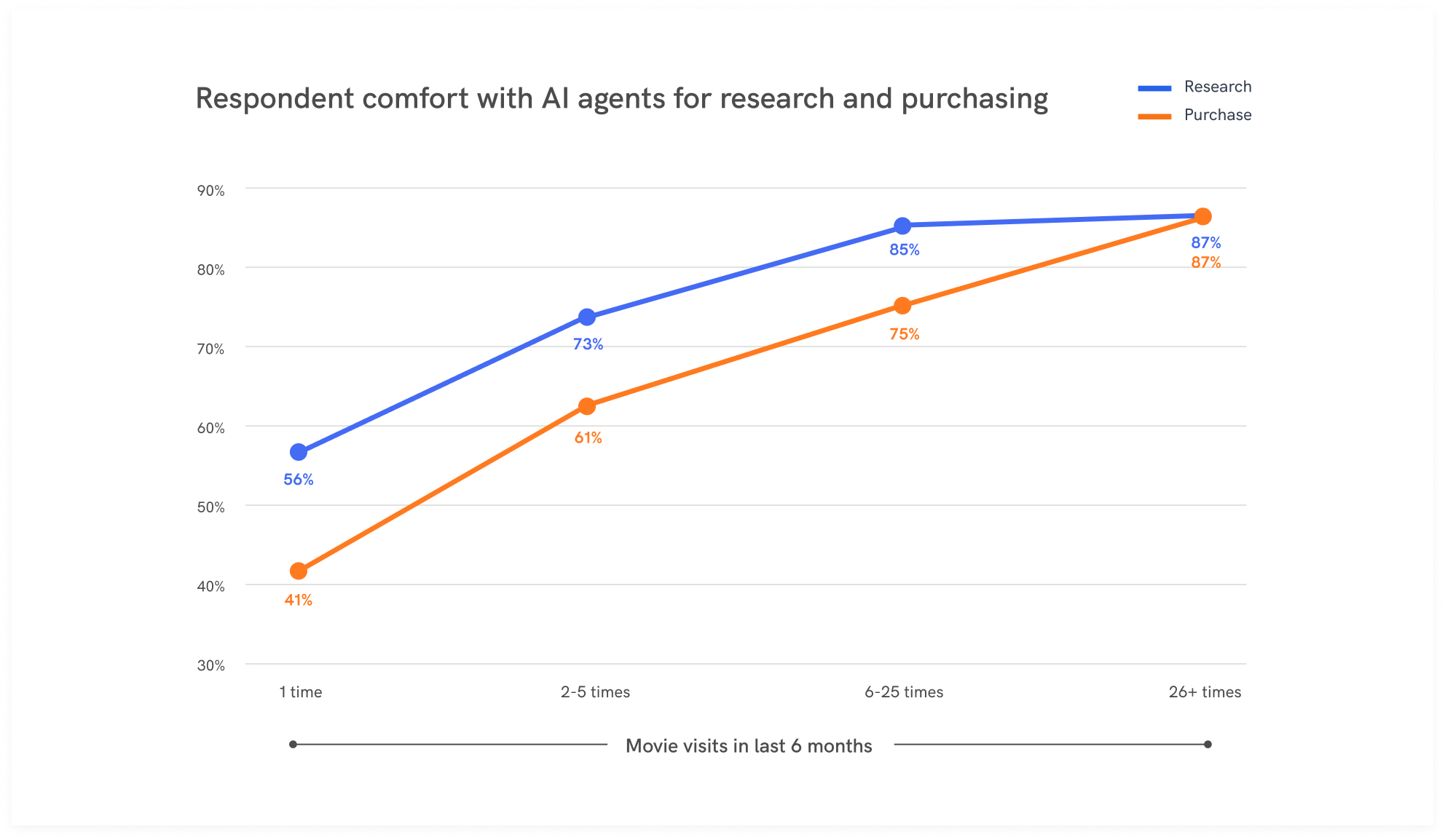
Cinema is well placed for this shift. In our recent US research, movies emerged as one of the top categories for AI-assisted discovery and purchase, alongside restaurants. 66% of all moviegoers are comfortable using AI to decide what to watch, and nearly half are open to letting AI agents pay for the booking. The more frequently people go to the cinema, the more comfortable they become, to the point where the gap between discovery and purchase almost disappears for the most avid moviegoers.
But moviegoer comfort comes with caveats. Security is their top concern, with trust in accuracy close behind. Our research makes it clear that moviegoers want clear security signals, reassurance around payment handling, and explanations as to why something was suggested. They want to review before committing, and they want it to be easy to change or undo decisions. So, while many will accept agentic assistance, most want to be in the loop to make key choices and have final approval.
That creates real pressure on the underlying technology. Exhibitors need infrastructure that holds the full journey together, from a moviegoer’s first intent until the last change they make to their booking. And in this fast-moving and uncertain environment, technology partners must evolve to meet the challenge for their clients.
Discoverability, and being the compelling choice
Upfront, we should tackle one of the most common vendor fears about agentic commerce: disintermediation. Much has been made of this risk without remembering that discovery-driven disintermediation has long existed outside exhibitor-owned channels via search, social, trailers, aggregators, and more. We aren’t moving from a perfect world to the Wild West.
To prevent disintermediation from becoming a greater risk, an agent will ideally discover an exhibitor directly and engage with them through each stage of the journey from discovery to payment. This relies on agents easily finding and understanding exhibitors, then seamlessly transacting with them. Exhibitors should make sure their own brand appears inside AI tools, and provide the best alternative for moviegoers to book, pay, and interact with them directly before and after the purchase. This can be achieved by connecting exhibitors’ ticketing, recommendations, and checkout systems directly to these AI platforms so the AI uses their systems to complete the booking.
The first step for exhibitors on this agentic commerce journey is to maximise their visibility for discovery. If an agent can’t read your showtimes, formats, locations, and pricing, you simply won’t show up. As the system of record for structured, real-time movie, moviegoer and cinema data, Vista helps fulfil this discoverability by keeping exhibitors machine-readable, trusted as the source of truth, chosen through first-party audience intelligence, and in control of the checkout. This means it is far easier to reliably and cleanly expose the right information in a way AI systems can use.
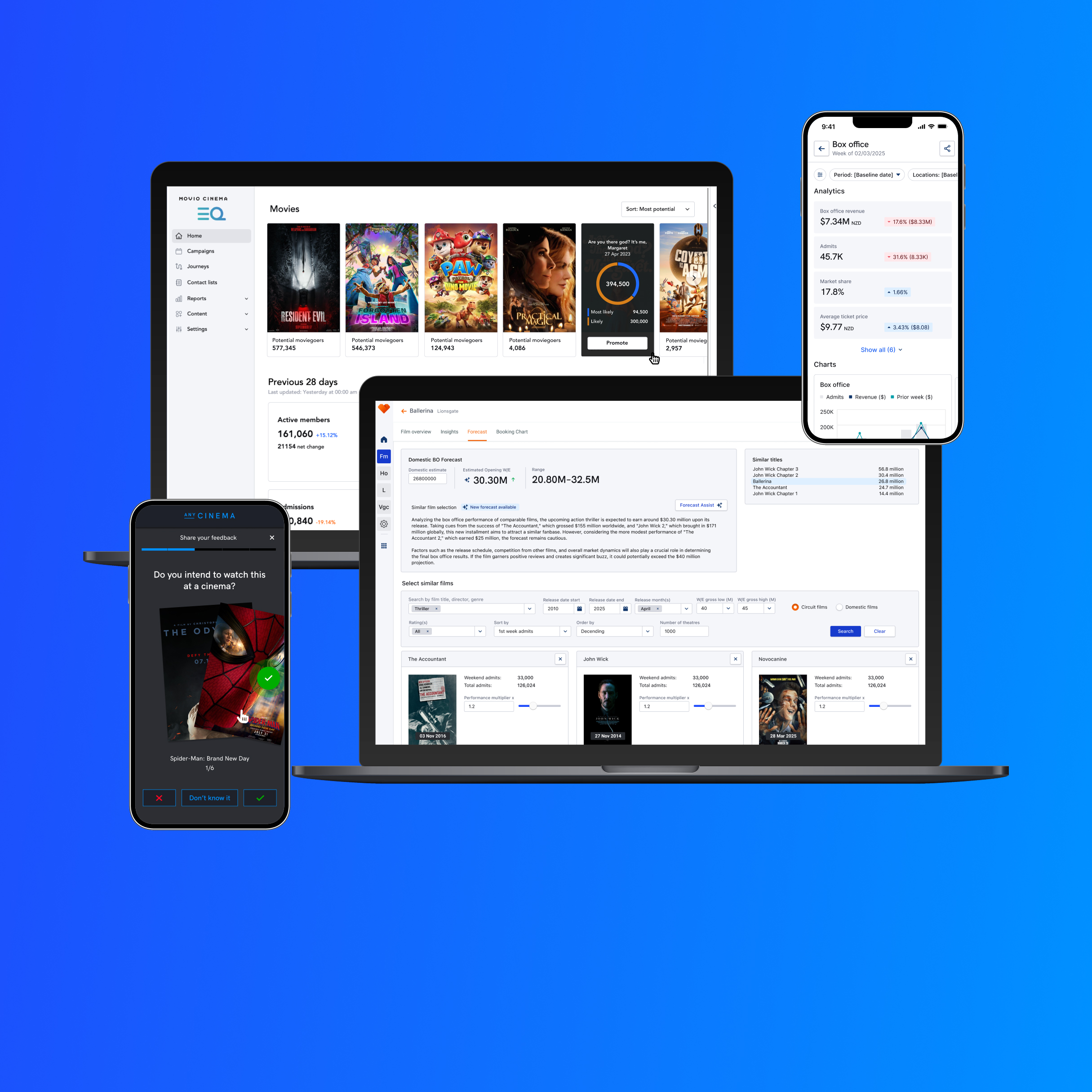
After discovery, the next challenge for exhibitors is to be compelling enough to be recommended. Agents follow signals to guide their recommendations, and for exhibitors, the strongest signals are built on first-party understanding of moviegoer behaviour. Movio has built detailed AI-augmented audience profiles based on years’ worth of transactions, demographics, and behaviour. React adds real-time sentiment and intent data, and Horizon unites it all. This data is ideal to move agentic search beyond a generic “here’s what’s on nearby” to “here’s exactly what this moviegoer is most likely to respond to tonight”.
AI agents look for the most reliable source of truth
There’s a related dynamic that matters more than may be immediately apparent. AI commerce platforms are more likely to favour sources that are complete, current, and executable, because these sources reduce risks of hallucination, stale prices, and failed transactions. The exhibitor is the natural source of this truth, because it is authoritative in ways outdated listings, scraped pages, or third-party aggregators can never be.
Vista’s white-labelled model is designed to keep the exhibitor as the visible commercial relationship, rather than shifting the moviegoer relationship to a third party. That, combined with Movio’s proprietary AI-driven profiling, helps how exhibitors are surfaced, selectable, and remain in control, even if the ‘front door’ to discovery disintermediates elsewhere.
Agentic bookings are the beginning of a living journey
Once the discovery and selection are complete, the journey moves to checkout and payment. Unlike physical goods like shoes, books, or groceries, cinema bookings are complex. Every cinema booking factors in location, showtimes, format, availability, as well as moviegoers’ favourite seats, treats, and more. An agent is essentially useless if it surfaces a great suggestion, but the underlying system can’t handle this real-world complexity.
By managing the execution layer, Vista can convert complex recommendations into actual bookings, facilitating payment in a way that allows exhibitors to remain the merchant of record and the owner of guest relationships and data.
Agentic assistance typically ends at payment. But Vista’s comprehensive platform, and the digital Living Ticket in particular, allows bookings to evolve within the same ecosystem, seamlessly passing from agents to guest self-service.
From a completed agentic booking, the Living Ticket enables moviegoers to add food, swap seats, or request refunds. They can modify their bookings based on how people actually behave, such as purchasing their tickets when a movie first goes on pre-sale, then adding their snacks the day of the show. And as they leave after the movie, React surveys them about the movie watched, their overall experience, and what they intend to see next, further enhancing the data used to create signals for agents to detect.
Our technology is embracing the future
Put together, the brief for exhibitors is solidifying. You need technology partners that can make your cinema visible and promoted to the top in a machine-readable world, to increase your chances of being chosen using first-party intelligence, to execute complex transactions reliably in your environment, and allow modifications until the lights in the auditorium dim, while retaining control of the guest relationship and maintaining trust at every turn.
It’s a demanding list, but it closely aligns with how Vista has been built. While agentic commerce is new, we’ve spent three decades solving the underlying challenge of uniting data, decision making, and execution into a cohesive-yet-open system that makes our clients more efficient and effective, while empowering them to deliver outstanding entertainment experiences. Agentic commerce is just the latest validation of our client-centric approach and we’re excited to rise to this latest challenge.









.svg)