

Box office records have masked declining attendance
North American cinemas just set a new summer box-office record of US$4.76 billion, yet attendance is still well below pre-pandemic levels. Between 1 January and 16 August, cinemas in the United States and Canada sold an estimated 568.4 million tickets, 30% fewer than over the equivalent period in 2019. As referenced in a recent New York Times headline, that is 248 million missing tickets.
Premiumisation explains why revenue and attendance are moving in different directions. Premium formats, recliners, and expanded food and beverage have made cinema a higher-cost occasion, and audiences have shown they’re willing to pay for those experiences. The offset is that they aren’t visiting as often.
Premiumisation improves yield. Frequency improves utilisation. The industry needs both to be sustainable.
The decline in frequency is behavioural
Movio Research shows that cinema’s frequency challenge is broad-based. The share of the US moviegoing audience classified as high frequency, meaning at least one visit a month, fell from 38.2% in 2017–19 to 25.0% since 2025, with every age and gender segment down. Of the 13.2 percentage-point fall, 12.9 points come from lower frequency within audience segments. Changes in the demographic mix account for only 0.4 points.
Reversing this is not about enticing one wayward segment back. It’s about giving all existing moviegoers clearer reasons to return more often: the right ‘next’ movies, considering all formats, at everyday prices, with a frictionless purchase path.
Not every movie needs to be watched with all the premium trimmings, and promoting the industry as such can discourage casual moviegoing. The industry should keep making its biggest blockbusters exceptional events, while giving existing moviegoers more reasons to return between major releases.
Five levers turn frequency into an operating system
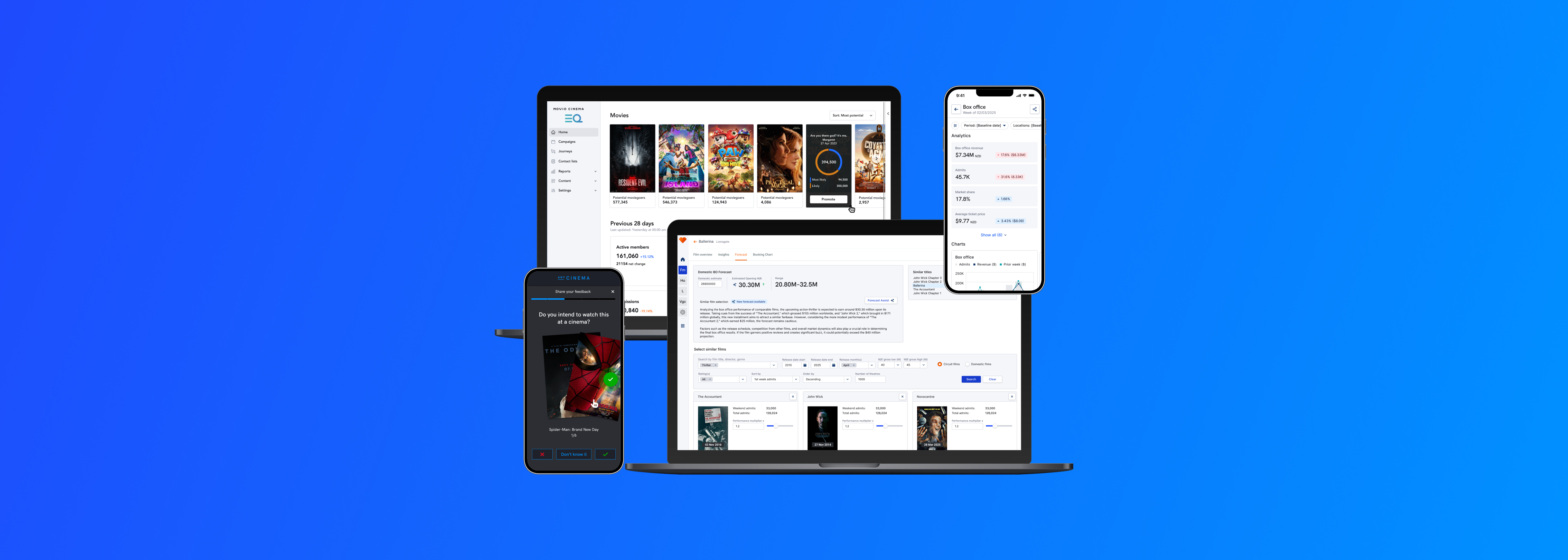
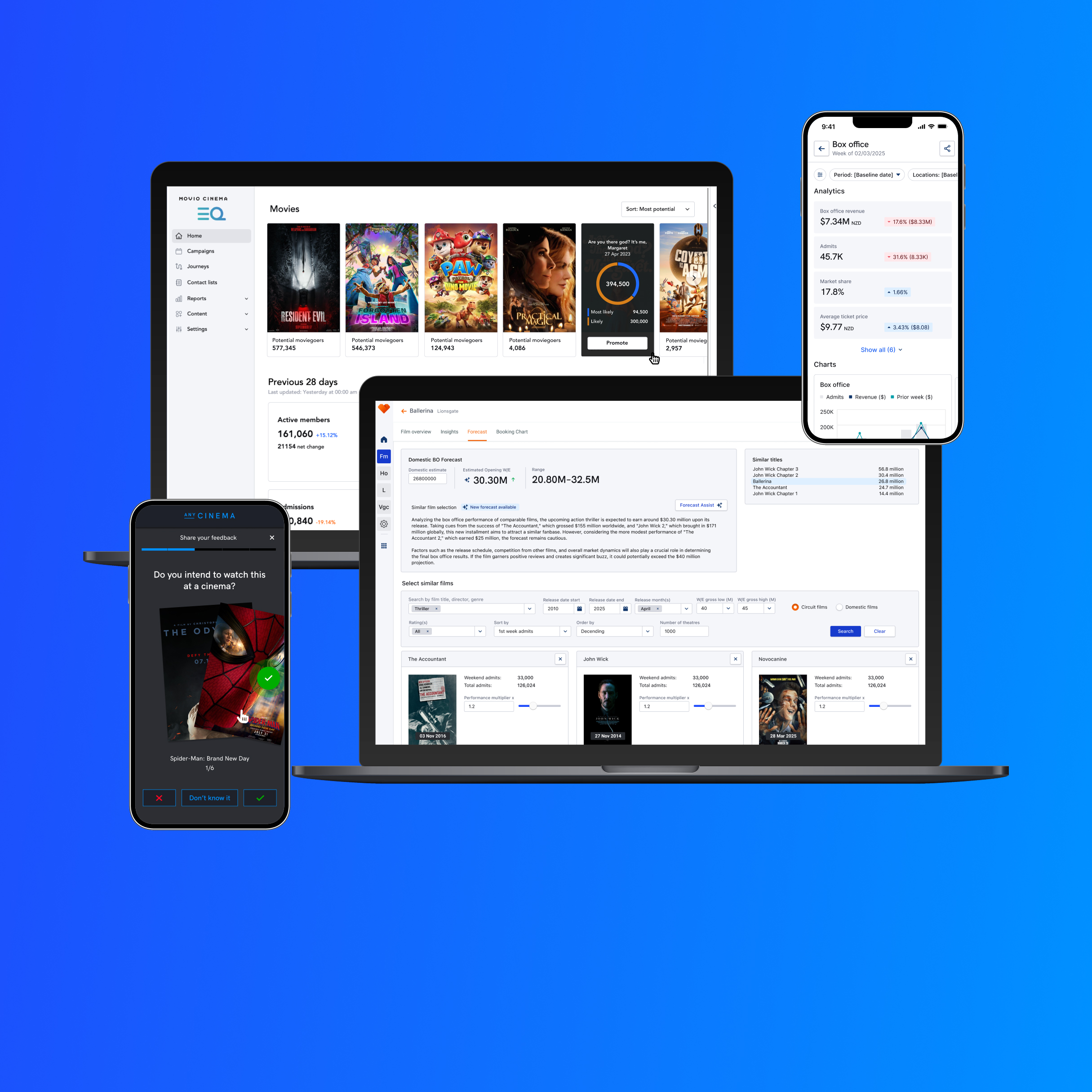
Vista helps exhibitors treat frequency as a measurable operating goal by forecasting demand, programming for regular visits, activating the right audience, using price and value levers with precision, and closing the loop after each visit.
There are three connected components. Horizon provides the data warehouse and unification layer behind those decisions. Vista Intelligence adds proprietary AI models that help teams decide what to programme, which guests to activate, when to create urgency, and whether an offer is likely to create an incremental visit rather than discount demand that already exists. Vista’s products then help teams put those decisions into market and measure the outcomes.
Take programming. Box Office Forecasting gives teams an earlier view of demand, while Assisted Scheduling in Film Manager uses demand, attendance, and movie-similarity signals to recommend programmes and screen allocation. Programmers stay in control, applying local knowledge, distributor context, and commercial judgement, but can look beyond obvious blockbusters to smaller movies, later weeks, and underserved audiences.
A better schedule creates the opportunity; audience activation converts it. Vista Intelligence surfaces movie-specific audience segments and recommends the filters, messages, and calls to action most likely to resonate. Movio EQ then helps exhibitors activate those audiences through personalised campaigns, using propensity, churn, customer lifetime value, and personas to distinguish between guests who need a timely prompt, a different reason to return, or no offer at all. Vista’s uplift methodology tests whether the activity attracted more moviegoers and created incremental revenue.
Price has a role, but blanket discounting gives away margin to guests who were already coming. The aim is to act only where a different price, offer, or loyalty benefit will drive an extra visit. Propensity, average transaction value, customer lifetime value, and offer-response signals can inform those choices. Faster ways to implement targeted promotions and adjust headline pricing also make experimentation easier.
Purchase friction matters too. A relevant movie, well scheduled and well marketed, can still lose to the couch if buying or managing the visit is difficult. Living Ticket and Vista’s self-service capabilities give guests more control over bookings and reduce the work around a cinema visit.
The experience itself determines whether somebody has a reason to return. Pulse survey React captures guest sentiment and intent after a visit. Horizon can combine that feedback with behavioural, transactional, and demographic information. Movio EQ can use the feedback signals for service recovery, and Oneview can surface feedback alongside movie, moviegoer, and theatre performance.
For exhibitors, the operating shift involves a greater focus on measuring frequency explicitly, finding the audiences whose visits are slipping, programming beyond the peaks, activating demand with propensity and churn signals, reducing friction, and calculating whether offers produce extra visits rather than cheaper ones.
The missing admissions are the opportunity
The 248 million missing admissions do not invalidate premiumisation. They represent opportunity: known moviegoers who still value cinema but now need stronger reasons to come back more often between the major events.
Exhibitors should keep making the biggest movie events feel exceptional while rebuilding the everyday habit around them. Premium visits lift yield. Everyday visits lift utilisation, total spend, and the opportunities to win the next visit. Premium events create the peaks. Everyday frequency rebuilds the base. Vista helps exhibitors grow both.







.svg)