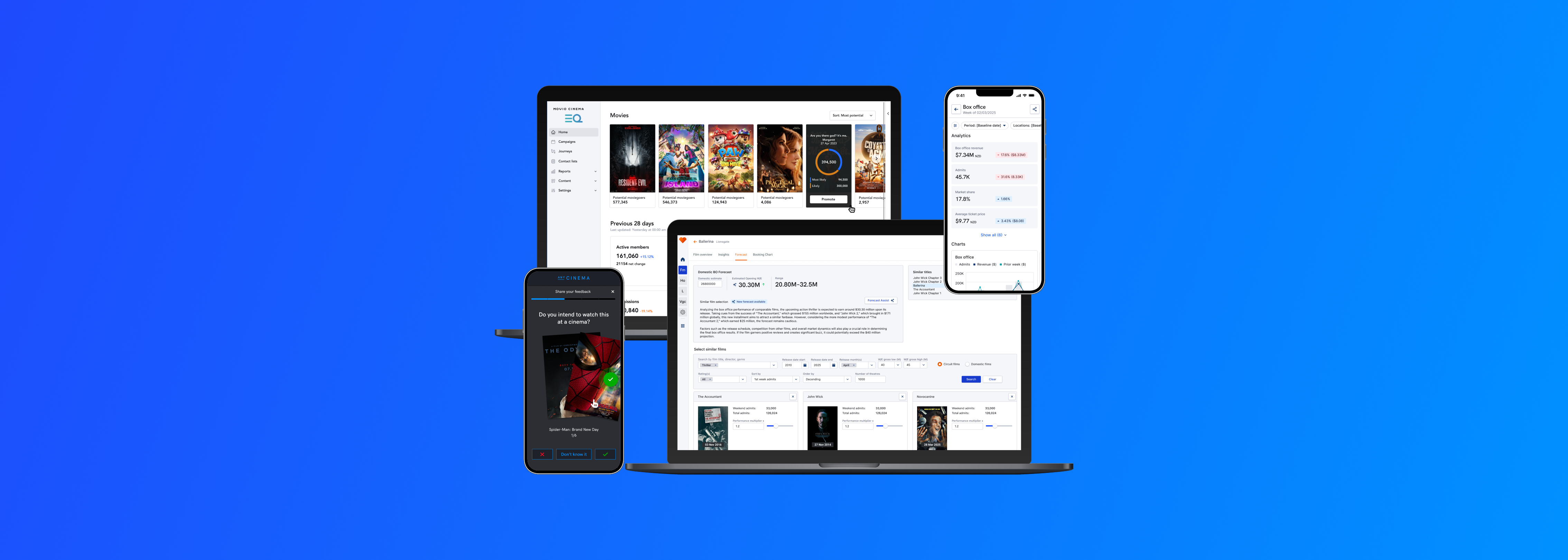
Understanding every aspect of your cinema’s operational performance is only as useful as what you can do with that information. Cinema operations are growing more complex, and teams face an ever-increasing number of decisions across marketing, programming, staffing and the guest experience. That’s why we’re focused on how insights lead to actions.
Vista Intelligence is the shared AI layer in Vista Cloud, built on the trusted audience, operational, transactional, and market data unified by Horizon. It transforms that data into predictions, insights, and recommendations that teams can act on through Vista Cloud applications and workflows. Each action feeds new data back into the ecosystem, helping refine subsequent recommendations so the benefits compound over time.
This wouldn’t be possible without the research, expertise, and hard work of our dedicated data science team. We sat down with Dr. William Caicedo, Vista Group’s Global Head of Data Science and Analytics, to better understand how Vista Intelligence empowers cinema decision making.
Turning insights into action
William, your team has been researching and developing machine learning algorithms and AI models for over a decade to support cinema decision making. Vista Intelligence now brings together a growing range of models spanning marketing, film programming, operations, concessions and more. What drives your decisions about which problems to tackle and which models to develop?
Ultimately, what we’re trying to do is empower people to make the best decision possible at any given time. These decisions span the entire cinema business; which campaign marketers should run for an upcoming movie, how to schedule movies that week, how to roster staff to match expected demand... We’re empowering those decisions by bringing together data from across their cinema circuits and transforming that data into predictions, insights, and recommendations.
Traditionally, analytics were about finding insights that tell a clear story about what happened in the past. Increasingly, it’s about predicting the future. But even predictions of the future are only useful if there is something you can do with that information.
One of the fundamental principles of Vista Intelligence is that insights need to be actionable. It connects predictions with recommended next steps and gives people the tools to put those recommendations into practice.
Building a virtuous cycle
Vista Group has been working with AI and machine learning for years, beginning with Movio’s audience similarity and propensity algorithms in 2016. How has the range of AI models that make up Vista Intelligence grown over that time into the transformative layer we have now?
It’s helpful to think in terms of problems you’re trying to solve. Developing any kind of tool, whether it’s ticketing software or an AI model or a screwdriver, begins with a problem to solve. If you’re building software first and trying to match it to a problem after, it’s never going to be the ideal answer.
Whenever we start researching or developing anything, we’re looking for a way to solve a problem for our clients.
What’s interesting about our work with machine learning and AI over the years is that setting out to solve one problem has often led us to create the tools that would later identify and solve other problems as well.
For example, let’s look at two challenges faced by different areas of a cinema: A marketing team wants to know the right communication to send, and the right moviegoers to reach with it, to maximise the potential of an upcoming film. At the same time, film programmers want to create an ideal schedule for their site for the upcoming week.
On the surface, these problems don’t seem closely connected.
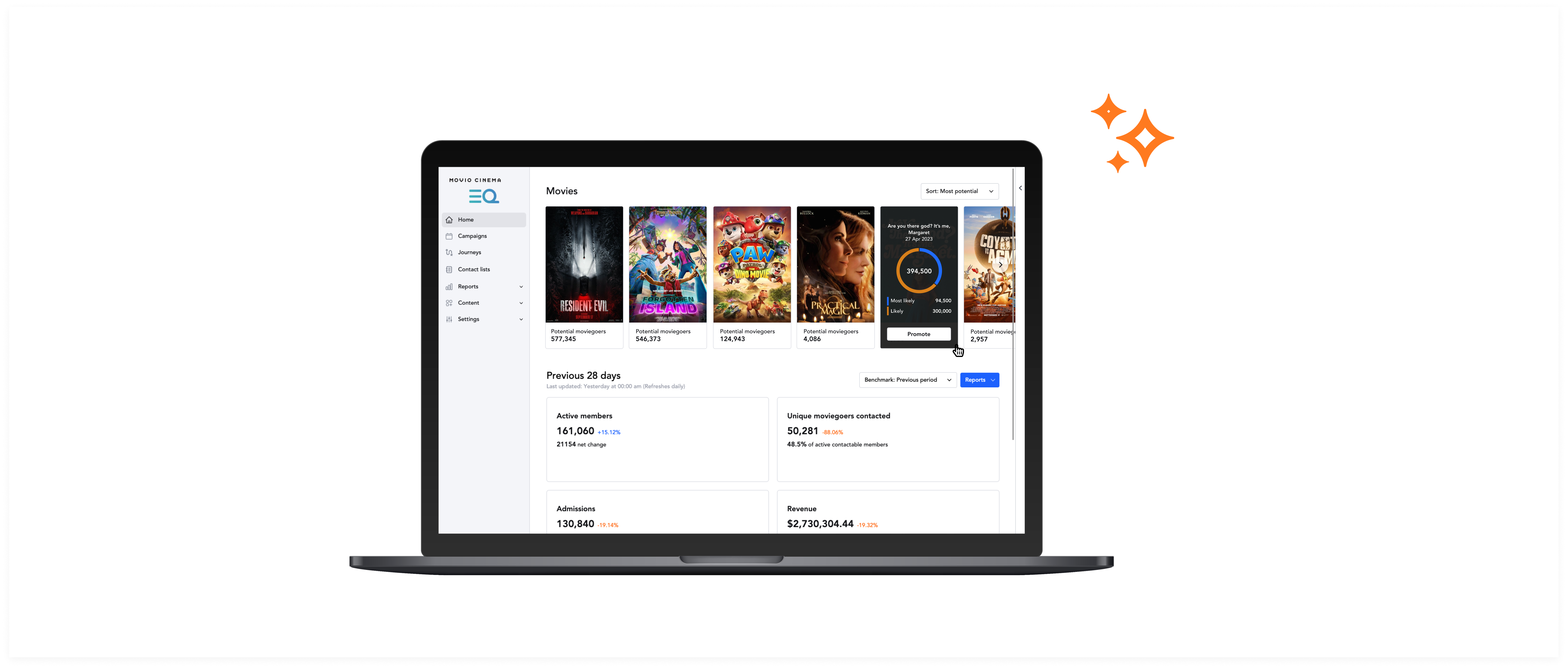
That first problem was what Movio set out to solve in 2016 with audience similarity. To identify the right audience for a campaign promoting an upcoming movie, you need to understand who’s likely to be interested in it. Since we can’t read people’s minds, we infer their interests from their behaviour. Audience similarity uses moviegoing behaviour to identify how alike audiences are and uses that information to recommend the right audience to focus on.
Propensity, our second model, builds on audience similarity by using machine learning to estimate moviegoer taste and predict how likely someone is to enjoy a particular movie. It’s a more advanced tool that substantially improved on audience similarity and enabled us to segment moviegoers according to their predicted movie interest in a more accurate way.
However, you run into a catch-22 when trying to find the right audience for a movie that hasn’t started showing yet: both propensity and audience similarity need some sessions to create a movie profile and work their magic, so a new release presents what we call a cold-start problem. This led us to create a new model—movie similarity—which solves that problem by finding suitable proxy movies to create a “synthetic” movie profile, optimised for propensity. It considers movie metadata such as genre, cast, and content characteristics, weighting them using moviegoer visitation patterns. That allows us to use propensity before the new movie has its own audience.
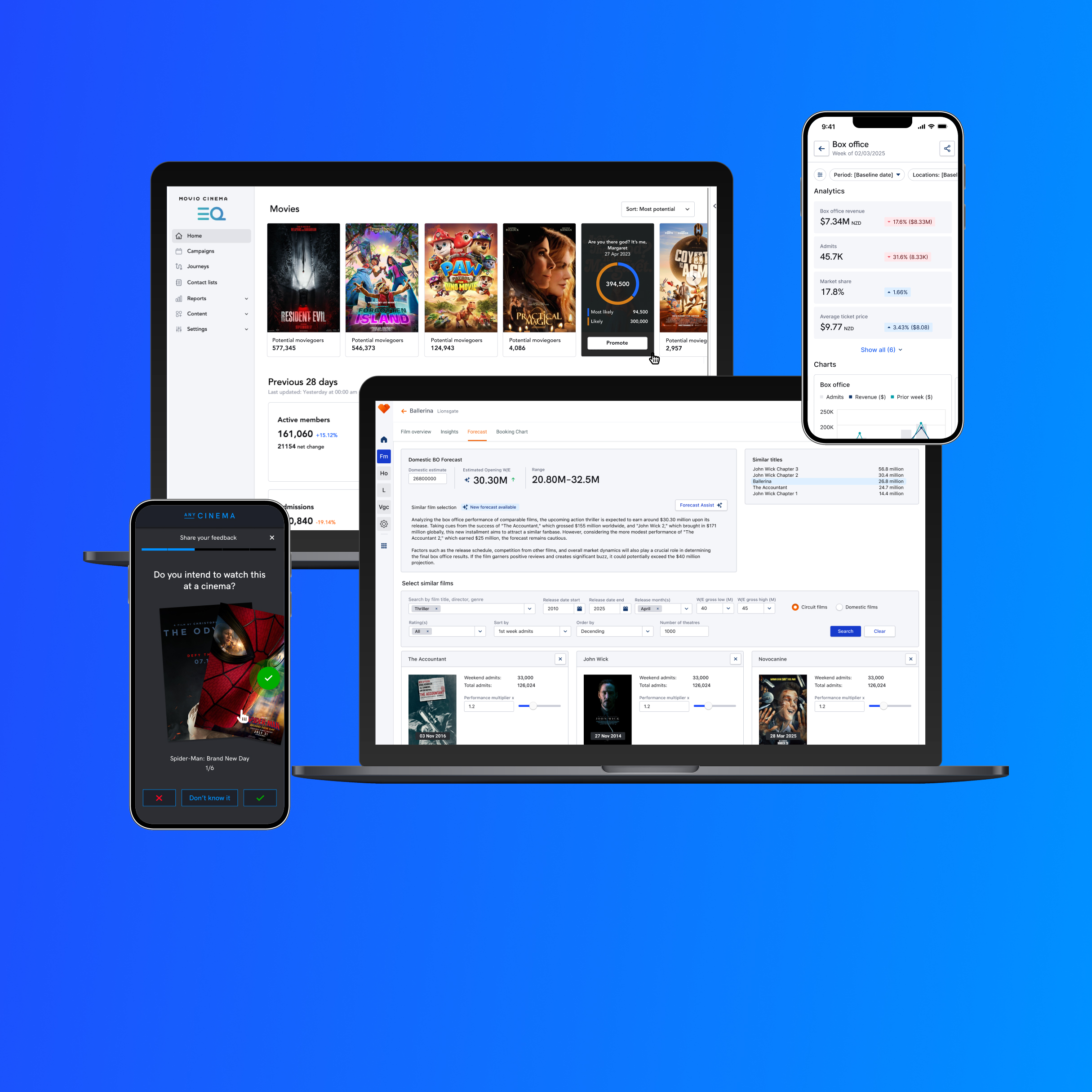
Movie similarity also supports box office forecasting. The same profile used by propensity helps our box office forecasting model estimate the relationship between pre-sales data and box office performance, informing forecasts for an upcoming movie.
We set out to solve a problem with audience similarity, and our work on it led us to develop propensity, and later movie similarity. The same movie profile created by movie similarity also supports box office forecasting, which in turn helps film programmers build schedules through assisted scheduling. Solving one problem has therefore helped us address others, connecting these models and tools in a growing ecosystem.
The insights from Vista Intelligence are also expanding to inform decisions across every department in interesting ways. For example, even property decisions like whether to change a cinema layout or invest in refurbishment are better informed by understanding the overall audience profile for that site.
Making it easier to move from numbers to reality
How does assisted scheduling help film programmers turn forecasts and recommendations into a practical schedule?
Assisted scheduling makes those insights practical by helping programmers put together a schedule informed by forecast demand. Rather than leaving them to translate predictions into showtimes manually, it helps them build the schedule itself.
Time is people’s scarcest resource. Anything we can do to help clients understand business insights or make decisions faster and more easily is therefore beneficial. This is where we’re seeing generative AI open up new opportunities.
Generative AI has changed what’s possible in many ways, but there’s a big difference between slapping a chatbot on top of something and incorporating the right solution for the problem.
For us, generative AI brings two capabilities to Vista Intelligence: it helps users understand their data and helps them act on it.
Something we’re working on right now is conversational analytics, which allows users to make natural language requests to an AI agent to help them interpret and understand their data more easily. To be useful, it needs the right context and a lot of our know-how baked in. We’ve therefore done extensive work on semantic modelling and embedding Vista’s industry knowledge, so that this generative AI layer draws on the expertise and value of the underlying insight models.
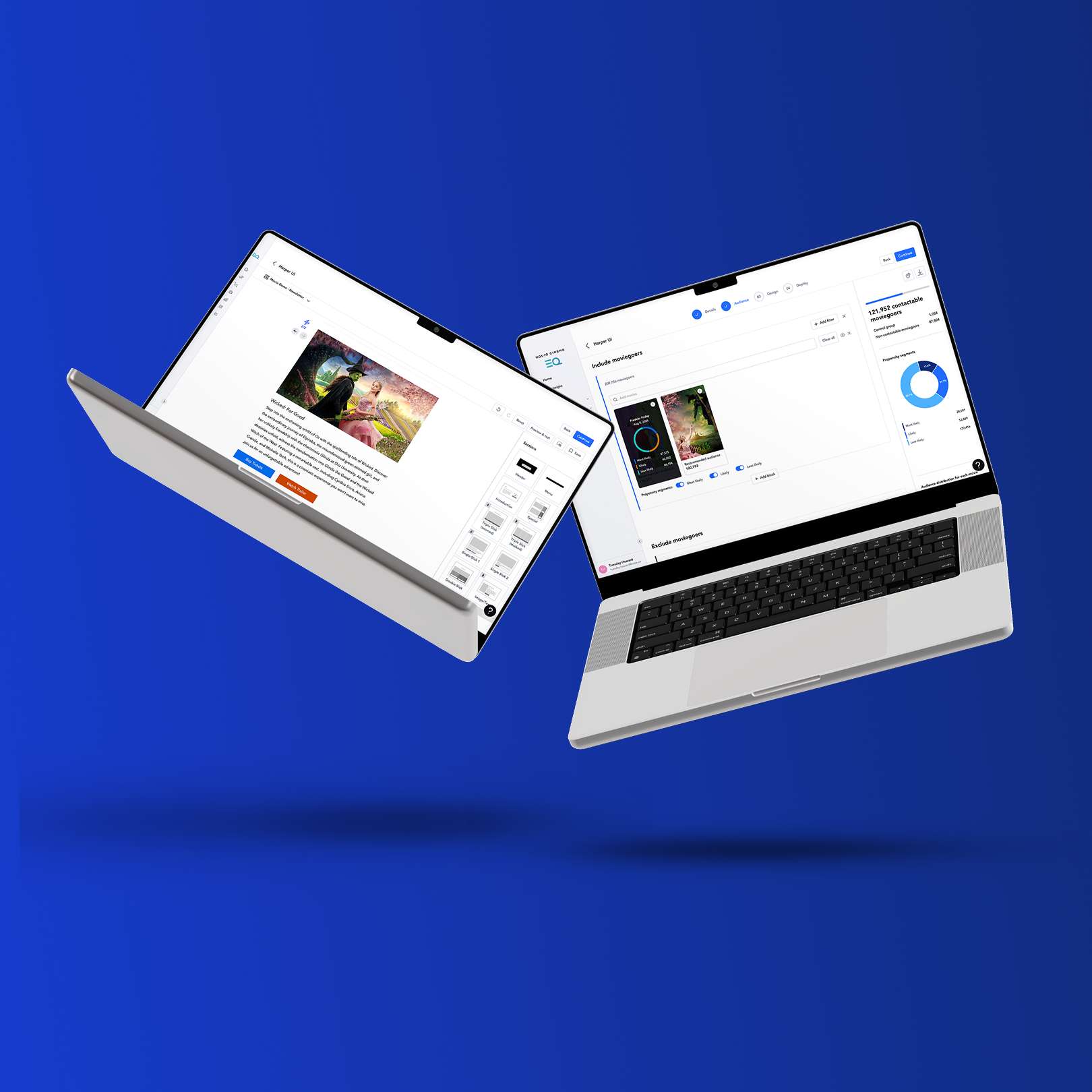
On the other side, when propensity, personas, and audience similarity recommend an effective marketing campaign to maximise attendance for an upcoming movie, someone still needs to put that campaign together. That takes time. Features like first draft use generative AI to make creating and sending the recommended campaign easier and more efficient, helping users act on that opportunity.
It comes back to the question of the problem you’re trying to solve. Our goal with Vista Intelligence is to enable people to make the best decisions, and take the most effective action. Incorporating generative AI makes it easier for people to take those actions.
Maintaining data and guest relationships
With the field of AI developing so rapidly, what is critical for exhibitors to successfully navigate the changing landscape?
AI is changing a lot of things, including the way moviegoers search for what to watch, make decisions, and purchase. Developments like agentic commerce open new opportunities for exhibitors, but it’s important to preserve the relationship they have with moviegoers, and to control their data.
If outside platforms manage the entire process, exhibitors lose control over the guest relationship, and someone else captures the data that they need to empower their future decisions.
Exhibitors need to stay at the centre. We’re giving them the tools to strengthen those relationships and amplify their sales channels, and Vista keeps data ownership explicitly in exhibitors’ hands.
That data is the seed of how they can make the right decisions to shape their future, with Vista Intelligence transforming it into actionable insights. Capturing and maintaining control over that data informs everything that follows. It’s critical not to lose sight of that.
It all begins with curiosity
As we continue to grow our layer of connected AI models with new opportunities to support cinema decision making, what’s driving the future of Vista Intelligence?
When you solve a problem, the journey can be just as important as the destination. Vista Group deserves a lot of credit: as an organisation of this size, it’s rare to have a research department like ours. We have 4 PhDs in the data science team, and that expertise guides and validates every model we create for Vista Intelligence. It’s a huge point of difference. On top of that, we’re given the freedom to engage in speculative research. We can ask questions such as, “What would happen if we pursued X? What about Y or Z?”
Not every question pays off in a new opportunity. But exploring what’s possible informs what we create and helps us discover opportunities to build things that make life easier for our clients, improve the insights and recommendations that inform their decision making, or even enable them to do things they couldn’t do before.
It’s the distillation of that freedom of research, combined with Vista’s industry expertise, that comes together to make Vista Intelligence.